A Thrilling Himalayan Adventure Across Three High Mountain Passes
Duration
33 Days
Activity
Trekking
Max. Altitude
5416
Difficulty
Challenging
The Manaslu Three Passes Trek is a strenuous high altitude trek requiring excellent physical fitness. Trekkers walk 6 to 8 hours daily on steep, rocky, and sometimes icy trails, crossing three challenging passes above 5,000 meters. Prior trekking experience and proper acclimatization are essential for a safe and rewarding journey.
Starts
Kathmandu
Ends
Kathmandu / Pokhara
Group Size
1 Pax
Best Season
Mar-May, Sep-Nov
TRIP HIGHTLIGHTS
Un spoiled and non-commercialized trekking route.
Of the beaten paths and an amazing experience.
So many of flora and fauna and wild lives.
Beautiful Monasteries high altitude lakes, glaciers sustaining views of mountains and passes.
Iconic villages such as, Mu Gompa, Lho, Samagaun, Bhimthang, Naar, Phu, Manang, Mustang etc.
Beautiful high altitude passes, Larkya La (5160 mtr) Kangla Pass (5322mtr) and Throngla pass (5416m)
Fusion of Unique Nepali and Tibetan culture in the local area.
Amazing magnificent Himalayan views of Manaslu, Ganesh Himal, Annapurna, etc.
TRIP OVERVIEW
Manaslu Three Passes Trek: A Challenging Journey Through Remote Himalayan Landscapes
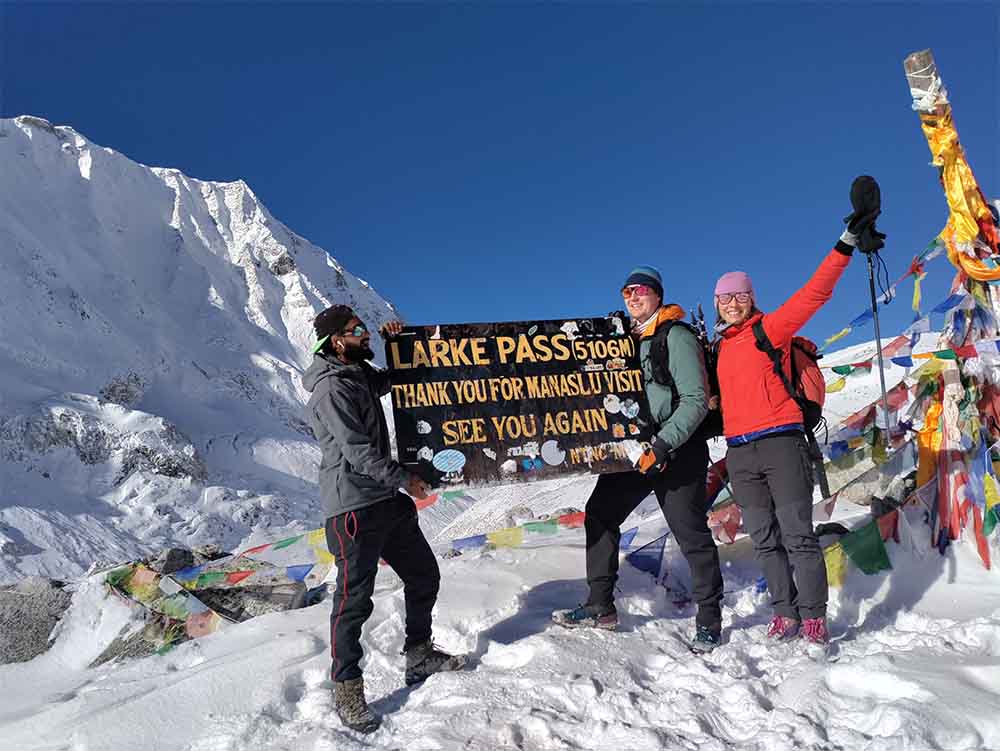
The Manaslu Three Passes Trekis one of the most exciting and difficult treks in Nepal. It takes you through remote areas of the Manaslu region, crossing three high mountain passes: Larke La Pass (5,106m), Rupina La Pass (4,610m), and Ngula Dhojhyang Pass (5,093m) in the Tsum Valley. This trek is perfect for adventurers looking for a less-traveled route, offering stunning views, traditional villages, and ancient Buddhist monasteries along the way.
The Manaslu Three Passes Trek allows you to experience three incredible high passes, each offering amazing views of the surrounding mountains. Starting from Machha Khola, you’ll walk through beautiful forests, terraced fields, and traditional villages. The trail takes you to Jagat, which is the entry point into the Manaslu Conservation Area, and you’ll also explore the culturally rich Tsum Valley.
The first big challenge is the Rupina La Pass (4,610m), a high-altitude pass known for its rugged landscape. From here, you can enjoy breathtaking views of Mount Manaslu (8,163m), the eighth highest mountain in the world. After crossing this pass, the trek takes you down into the Budi Gandaki Valley, where you’ll pass by old villages and monasteries that hold great cultural value.
Table of Contents
Next is the Ngula Dhojhyang Pass (5,093m) in the Tsum Valley, which is a spiritual and peaceful place. This valley has been secluded for a long time, keeping its traditional Tibetan culture and practices alive. You’ll visit important monasteries like Mu Gompa and Rachen Gompa, where the local monks and nuns carry on ancient Buddhist traditions.
The final pass, Larke La Pass (5,106m), is a tough but rewarding climb. The view from the top is worth the effort, offering stunning sights of mountains like Himalchuli, Cheo Himal, and Kang Guru. After crossing Larke La, you’ll descend to Bimtang, a peaceful village where you can rest and take in the views before finishing the Manaslu Three Passes Trek.
Culture in the Manaslu Region
TheManaslu region has a unique mix of Tibetan and Nepali cultures. Its close location to Tibet influences many local traditions. The main groups living here are the Nubri and Tsum people, who follow Buddhist practices. You can see many monasteries and prayer flags around, showing how important Buddhism is to their lives. The Tsum Valley is special for Buddhists, as it’s a key pilgrimage site. Festivals like Lhosar, which is the Tibetan New Year, are celebrated with lively events. People gather for traditional dances, rituals, and prayers at the monasteries.
The food in the Manaslu region mainly comes from what is grown locally. Barley, potatoes, and buckwheat are common ingredients. These are used to make dishes like tsampa, which is roasted barley flour, and momo, which is dumplings. People often drink yak butter tea and eat churpi, a type of hard cheese. The culture is also reflected in their clothing. During festivals and daily life, people wear traditional Tibetan-style outfits. The blend of Tibetan and Nepali traditions can be seen in both their food and way of life.
Food and Accommodation in Manaslu Three Passes Trek
The food and accommodation on theManaslu Three Passes Trek are simple but suitable for the remote area. Most of the lodges and teahouses serve basic meals made from local ingredients. Common dishes include dal bhat, which is rice with lentil soup, noodles, and momos, which are dumplings. Since the region is at a high altitude, yak butter, cheese, and meat are often used in meals. Hot drinks like tea are a favorite among trekkers, especially to stay warm in the cold weather. Although the food choices might be limited as you go higher, it provides enough energy to keep going on the trek.
Accommodation is mostly in teahouses, offering a basic yet cozy place to sleep. The rooms are usually shared and might have blankets, but it’s a good idea to bring a sleeping bag for extra warmth at higher altitudes. Guides from Manaslu Guides will make sure to find the best possible places for you to stay during the Manaslu Three Passes Trek. They will help arrange the food, ensuring it’s healthy and suited for the trek’s demands. Their experience in the region means they know the best lodges and meals, giving you a more comfortable and enjoyable experience. With their help, the Manaslu Three Passes Trek will be well-organized, and you can focus on the adventure ahead.
Best Season and Time for Manaslu Three Passes Trek
Spring (March to May)
Spring is one of the most ideal times for the Manaslu Three Passes Trek. The weather is generally good, with clear skies and pleasant temperatures during the day. The hillsides are full of blooming rhododendrons, which add beautiful colors to the trek. During the day, it’s usually warm enough for trekking, but the temperatures drop at night, especially in higher areas. This is a great season for the Manaslu Three Passes Trek if you want to enjoy nature at its best and experience the beauty of the region.
Summer/Monsoon (June to August)
Summer brings the monsoon season, and the Manaslu region experiences heavy rainfall during this time. The Manaslu Three Pass Trek can get muddy, making trekking more difficult, and there is a higher risk of landslides. The views of the mountains are often hidden behind clouds, and you may encounter leeches in the lower areas. However, if you prefer fewer crowds and don’t mind the rain, it’s possible to trek during the monsoon, but you’ll need to be prepared for wet and slippery conditions.Autumn (September to November)
Autumn (September to November)
Autumn is the best time for trekking the Manaslu Three Passes Trek. The weather is perfect for trekking after the monsoon rains, with clear skies and stunning views of the mountains. The temperatures are comfortable, neither too hot nor too cold, making it easier to trek at higher altitudes. This season is popular with trekkers because of the ideal conditions, but it’s still less crowded compared to other trekking routes like Everest or Annapurna. The fresh greenery from the monsoon makes the scenery even more beautiful.
Winter (December to February)
Winter is a tough season for the Manaslu Three Passes Trek. The temperatures drop significantly, especially at night, and there is often heavy snowfall. the high passes, like Larke La Pass, can get blocked by snow, making the trek difficult or even impossible. If you are an experienced trekker looking for a real adventure, winter can still be an option, but you will need to be well prepared for the cold. Some parts of the route might need to ve changed if there is too much snow.
If you’re planning for the Manaslu Three Passes Trek during winter, it’s best to check the weather conditions beforehand and be ready for colder temperatures and more challenging terrain. For most trekkers, spring and autumn are the best times to go for a safer and more enjoyable experience.
What can you Expect in Manaslu Three Passes Trek?
The Manaslu Three PassesTrek offers a mix of adventure, stunning landscapes, and unique cultural experiences. Here’s what you can look forward to during this challenging yet rewarding trek:
Incredible Mountain Views
Throughout the Manaslu Three Passes Trek, you’ll witness some of the most beautiful mountain scenery in Nepal. Expect to see towering peaks like Mount Manaslu (8,163m), Himalchuli, Cheo Himal, and Kang Guru. The views from the three high passes, especially Larke La Pass, are breathtaking, giving you amazing panoramic sights of snow-capped mountains.
Tough High Pass Crossings
You will cross three high passes: Rupina La Pass (4,610m), Ngula Dhojhyang Pass (5,093m), and Larke La Pass (5,106m). These passes are physically demanding, with steep climbs and descents, but they reward you with fantastic views and a real sense of accomplishment. The Manaslu Three Passes Trek will be tough, with high altitudes and long hiking days, so good fitness and proper acclimatization are important.
Remote and Quiet Trails
The Manaslu region is much quieter than busy trekking areas like Everest or Annapurna. You’ll pass through peaceful villages, forests, and open valleys where only a few trekkers go. The trails are less crowded, giving you a true sense of adventure and isolation. You’ll often find yourself alone in the mountains, surrounded by nature.
Rich Tibetan style Culture
As you walk through the villages in the Tsum Valley and Budi Gandaki Valley, you’ll experience the local culture, which is deeply influenced by Tibetan Buddhism. You’ll see traditional Tibetan homes, colorful prayer flags, and mani walls with prayers carved into them. You’ll also visit old monasteries like Mu Gompa and Rachen Gompa, where monks practice ancient Buddhist rituals.
Varied Landscapes and Wildlife
The Manaslu Three Passes Trek takes you through a range of landscapes, from green forests and terraced farmlands to rocky mountain paths and high-altitude meadows. The Manaslu Conservation Area is home to rare wildlife, so you might spot animals like Himalayan blue sheep or even snow leopards, as well as different species of birds along the route.
Trekking at High Altitude
Since you’ll be trekking at altitudes above 5,000 meters, you need to be cautious about altitude sickness. You’ll have to acclimatize properly and avoid rushing up the trail. The experienced guides from Touch The Himalaya Treks and Expedition will help you maintain a safe pace and ensure you acclimatize well.
Simple Teahouse Lodging
Along the Manaslu Three Passes Trek, you’ll stay in local teahouses, which are basic lodges run by families. The rooms and meals are simple, offering local dishes like rice, noodles, and soups to keep your energy up. Though the accommodations are not luxurious, the friendly hospitality of the locals will make your stay enjoyable.
An Unforgettable Experience
Overall, you can expect a tough but thrilling adventure. The Manaslu Three Passes Trek is not only a physical challenge but also a cultural and spiritual journey. You’ll be surrounded by the beauty of the Himalayas and get to know the local communities, all while crossing some of the highest passes in the region.
Difficulty Level of Manaslu Three Pass Trek
Long Trekking Hours
You will need to hike for 6 to 8 hours each day on difficult trails. Some days will be even longer, and the steep ascents and descents make the Manaslu Three Passes Trek physically demanding.
High Altitudes
The Manaslu Three Passes Trek takes you above 5,000 meters, with the highest points at Larke La Pass (5,106m) and Ngula Dhojhyang Pass (5,093m). There’s a high chance of altitude sickness, so it’s important to acclimatize well and go slowly.
Difficult Pass Crossings
You will cross three high mountain passes – Rupina La Pass (4,610m), Ngula Dhojhyang Pass, and Larke La Pass. These passes have steep sections, snowy trails, and tough weather conditions, making them a real challenge.
Remote and Rough Trails
The Manaslu Three Passes Trek goes through remote areas where the trails are narrow, rocky, and uneven. You’ll be far from any modern comforts, which makes both the physical and mental challenges harder.
Unpredictable Weather
Weather in the high Himalayas changes quickly, especially at higher altitudes. Cold temperatures, snow, or rain can make the trek more difficult, especially when crossing the passes.
Fitness Level Needed
You need to be in good physical shape to complete the Manaslu Three Passes Trek. It’s important to have prior hiking or trekking experience to handle the tough terrain and long walking days.
Basic Lodging and Amenities
The teahouses along the Manaslu Three Passes Trek provide only basic facilities. The lack of modern comforts, especially at higher altitudes, adds to the overall difficulty of the journey.
Mental Strength
Along with physical endurance, mental strength is crucial. The long, tough days of trekking in challenging conditions can be exhausting, so staying motivated is important to finish the trek successfully.
How to trek safely in Manaslu Three Pass Trek
The Manaslu Three Passes Trek is a tough but unforgettable journey through quiet and untouched Himalayan landscapes. The trail leads across high mountain passes, remote valleys, and rugged paths where you may walk for hours without seeing other trekkers. Life is simple in this region, and facilities are very limited. Because of the long days, high altitude, and changing weather, safety becomes a major part of the experience. Being well prepared, understanding your body, and respecting the mountains helps make this challenging trek safer and more enjoyable.
Walk at a Comfortable Pace
Move steadily along the trail and avoid rushing. Walking at a relaxed pace helps your body adjust to altitude and reduces tiredness. Take short and regular breaks, especially while climbing uphill.
Stay Well Hydrated
Drink water frequently throughout the day, around 2–3 liters if possible. Proper hydration keeps your energy level steady and helps reduce altitude discomfort. Avoid alcohol and smoking, as they slow acclimatization.
Eat Warm and Energy Rich Food
Choose warm meals such as rice, dal bhat, soups, noodles, and potatoes. Carry small snacks like nuts, chocolate, or energy bars to eat during breaks. Eating often helps maintain strength during long walking days.
Pay Attention to Your Body
Headache, dizziness, or unusual tiredness are signs to slow down or rest. Altitude affects everyone differently, so do not ignore any discomfort. If symptoms continue, descend slightly and recover before continuing.
Be Prepared for Weather Changes
Mountain weather can shift quickly. Carry layered clothing, a rain jacket, gloves, and a warm hat. Starting early in the day helps avoid strong winds or afternoon rain.
Trek with a Licensed Guide
A licensed guide who knows the Manaslu route helps keep you on safe trails and monitors your health. Guides are required in restricted areas and are valuable during emergencies.
Carry Proper Trekking Gear
Use good trekking boots and carry essentials such as a headlamp, warm clothing, a basic first-aid kit, water purification, and high-energy snacks. The right gear improves both safety and comfort.
Keep Permits and Identification Handy
Manaslu trekking requires special permits. Carry them at all times and keep extra copies in a separate bag to avoid problems at checkpoints.
Manaslu Guides will help you get all the necessary permits, making the process easy and stress-free before the Manaslu Three Passes Trek. Our local knowledge will guide you through the rules and requirements smoothly, saving you both time and effort. We know the regulations for the Manaslu region well and will make sure all the permits are obtained properly and on time. Along with managing the paperwork, We can also give you useful information about the restricted areas and conservation efforts. This allows you to enjoy the Manaslu Three Passes Trek while we take care of all the legal and logistical details.
Insulated Jacket: A down or synthetic jacket for cold weather.
Trekking Pants: Quick-drying and comfortable.
Waterproof Pants: For protection against rain and snow.
Trekking Socks: Several pairs of moisture-wicking socks.
Warm Hat: To keep your head warm.
Sun Hat or Cap: For sun protection.
Gloves or Mittens: Insulated and waterproof if possible.
Buff or Neck Gaiter: For warmth around the neck.
Personal Items
Water Bottles or Hydration System: To stay hydrated.
Sunscreen: High SPF for protection against UV rays.
Lip Balm: With SPF to protect your lips.
First Aid Kit: Basic supplies for emergencies.
Personal Medications: Any necessary prescriptions.
Toiletries: Biodegradable soap, toothbrush, toothpaste, etc.
Towel: Quick-drying travel towel.
Footwear
Trekking Boots: Sturdy, waterproof, and broken-in.
Camp Shoes: Lightweight sandals or sneakers for relaxing in the evening.
Gaiters: To keep dirt and snow out of your boots.
Food and Snacks
Energy Bars or Trail Mix: For quick snacks on the trail.
Electrolyte Tablets: To stay hydrated.
Gear
Backpack: A comfortable daypack (20-30 liters) for daily use.
Sleeping Bag: Rated for cold weather (0°C or lower).
Trekking Poles: For stability on the trails.
Headlamp or Flashlight: With extra batteries.
Miscellaneous
Camera: To capture the stunning scenery.
Power Bank: For charging devices.
Travel Insurance Documents: Keep a copy handy.
Cash: Local currency for small purchases along the way.
This list will help ensure you have everything you need for a safe and enjoyable the Manaslu Three Passes Trek through the Manaslu region.
Itinerary
Expand AllCollapse
All
DAY 01
Arrival in Kathmandu (1,400 m)
Max. Altitude: 1,400m/4,593ft. Distance: About 5.5 to 6 kilometers Duration: Around 15 to 20 minutes Meals: Breakfast Accommodation: 2/3 Star Hotel
Airport pick up and hotel transfer
Rest of the day is free at leisure
Overnight stay at your hotel in Kathmandu
Max. Altitude: 1,400 mBreakfast2/3 Stars Hotel
DAY 02
Trek preparation and Kathmandu Sightseeing
Route: Kathmandu
Max Altitude: 1,400m / 4,593ft
Distance: 5.5–6 km
Duration: 15–20 min
Meal: Breakfast
Accommodation: 2/3 Star Hotel
Hotel breakfast
Pick up by our team and head to our office for your trek briefing and preparation
Afternoon sightseeing in Kathmandu
Kathmandu Durbar Square
Swayambunath Monkey Temple
Drop of at your hotel
Overnight in Kathmandu
Max. Altitude: 1,400m/4,593 ft.Breakfast 2/3 stars hotel3-4 hrs walk
DAY 03
Drive Kathmandu to Machha-Khola 7-8 Hours drive
Max. Altitude: 870m/2,952ft Distance: About 140 to 160 kilometers Duration: Around 7 to 8 hours Meals: (B-L-D) Breakfast/Lunch/Dinner, Accommodation: Guest house/ Lodge
Early morning breakfast at hotel then Check-out the hotel, Our staff will pick you up and drive you to the bus park or a private vehicle. We travel by a beautiful bus or jeep to Machha-Khola, which is where the Manaslu Area and the Trek begin. Dinner and an overnight stay at the Machha-Khola Hotel.
Travelers Note: Machha-khola is a tiny town well known for selling locals from the northern portion of the Gorkha District. The majority of the population is Buddhist and Hindu, and the town is located on the bank of the Bhudhi Gandaki River, which originates in the Tsum Valley and Larke Pass The majority of the route is along the Budhi Gandaki River’s bank. You may anticipate seeing waterfalls, seeing monkeys, rice fields, lush forests, and, if the weather permits, getting our first glimpses of the Ganesh Himal. If you look out on the road, there’s a good possibility you’ll also see waterfalls as you pass by a number of local landmarks.
Max. Altitude: 870m/2,952ftBreakfast / Lunch / DinnerTea house / Lodge7-8 hrs walk
We pass some waterfalls, stone paves ways and a mani wall
Arrival in Jagat
Dinner and overnight stay in Jagat
Traveler’s note: Amazing views of the Ganesh and Shingri Himal await us today, from Jagat the previous restricted trekking area will start along with our adventure!
Max. Altitude: 1,340m/4,395ftBreakfast / Lunch / DinnerTea house / Lodge5-6 hrs walk
Followed by a flat leveled plateau we continue until reaching the river crossing
Cross the suspension bridge over the Bhudi Gandaki and enter Philim village
Climbing uphill further until reaching Ekle Bhatti
Now we enter the Tsum Valley and head to Lokpa village
Dinner and overnight stay at Lokpa
Traveler’s note: Today we will enter the Hidden Tsum Valley famous for its rich Tibetan culture, mani walls, and amazing views of the Shingri Himal.
Max. Altitude: 2,440m/8,005ftBreakfast / Lunch / DinnerTea house / Lodge 5-6 hrs walk
DAY 06
Lokpa hike to Chumling (2,386m)
Route: Lokpa – Chumling
Max Altitude: 2,386m / 7,828ft
Distance: 14 km
Duration: 6–7 hours
Meal: Breakfast / Lunch / Dinner
Accommodation: Tea House / Lodge
Breakfast and departure
We hike uphill for about 4 hours towards Chumling
Here we get time to visit the Gompas and enjoy the amazing views
We can choose to camp here or head back to Lokpa for our overnight stay
Traveler’s note: Chumling is famous for its Gompas and prayer wheels, as it lays south of the Shingri Himal incredible views can be seen from here of the Ganesh Himal!
Max. Altitude: 2,386m/7,828ftBreakfast / Lunch / DinnerTea house / Lodge 3-4 hrs walk
DAY 07
Chumling trek to Chhokan Paro (3,031m)
Route: Chumling – Chhokan Paro
Max Altitude: 3,031m / 9,944ft
Distance: 9 km
Duration: 5–6 hours
Meal: Breakfast / Lunch / Dinner
Accommodation: Tea House / Lodge
Breakfast and departure
Today is more of a long walk than an actual heavy trekking
Enjoying the views until we reach Chhokan Paro
Dinner and overnight stay in Chhokan Paro
Traveler’s note: Did you know that Chhokan Paro consists of 2 settlements making up the biggest town in the Tsum Valley? Amazing views of the Ganesh Himal and authentic Tibetan Buddhist culture await today!
Max. Altitude: 3,031m/9,944ftBreakfast / Lunch / DinnerTea house / Lodge 8-9 hrs walk
DAY 08
Chhokan Paro trek to Mu Gompa (3,700m)
Route: Chhokan Paro – Mu Gompa
Max Altitude: 3,700m / 12,139ft
Distance: 5 km
Duration: 2–3 hours
Meal: Breakfast / Lunch / Dinner
Accommodation: Tea House / Lodge
Breakfast and departure
We head north towards Mu Gompa
We trek past rustic villages and mani walls
Dinner and overnight stay in Mu Gompa
Traveler’s note: at Mu Gompa, we get to see the harmonious Buddhist culture and ceremonies, various concerns, and a visit to the Milarepa Cave. Make sure you have your camera ready!
Max. Altitude: 3,700m/12,139ftBreakfast / Lunch / DinnerTea house / Lodge 8-9 hrs walk
DAY 09
Mu Gompa trek back to Chumling (2,386m)
Route: Mu Gompa – Chumling
Max Altitude: 2,386m / 7,828ft
Distance: 17–18 km
Duration: 5–6 hours
Meal: Breakfast / Lunch / Dinner
Accommodation: Tea House / Lodge
Breakfast and departure
Today we head back to Chumling to continue our trek westwards
The trail is mostly downhill and easygoing
Dinner and overnight stay back in Chumling village
Max. Altitude: 2,386m/7,828ftBreakfast / Lunch / DinnerTea house / Lodge7-8 hours walk
DAY 10
Chumling trek to Deng (1,860m)
Route: Chumling – Philim – Deng
Max Altitude: 1,860m / 6,102ft
Distance: 12–20 km
Duration: 6–7 hours
Meal: Breakfast / Lunch / Dinner
Accommodation: Tea House / Lodge
Breakfast and departure
We retrace our steps back towards Philim
Here we head toward the direction of Ghap
Following the trail until reaching Deng village
Dinner and overnight stay at Deng
Max. Altitude: 1,860m/6,102ftBreakfast / Lunch / DinnerTea house / Lodge7-8 hrs walk
DAY 11
Deng trek to Namrung (2,630m)
Route: Deng – Ranagoan – Bihi Phedi – Ghap – Namrung
Max Altitude: 2,630m / 8,628ft
Distance: 19.5 km
Duration: 5–6 hours
Meal: Breakfast / Lunch / Dinner
Accommodation: Tea House / Lodge
Breakfast and departure
Starting by heading down to the riverside
After crossing the bridge, an upward climb takes us to Ranagoan
From here, we trek further to Bihi Phedi
The trail splits into two, and we take the right-side trail to Ghap
After passing through Ghap village, we climb up to Namrung
Dinner and overnight stay at Namrung village
Traveler’s note: Today we get clear views of the Ganesh, Shingri, and Kutang Himal.
Max. Altitude: 2,630m/8,628ftBreakfast / Lunch / DinnerTea house / Lodge 3 hrs walk
DAY 12
Namrung trek to Lho (3,180m)
Route: Namrung – Lihi – Sho – Lho
Max Altitude: 3,180m / 10,433ft
Distance: 10.5 km
Duration: 4–5 hours
Meal: Breakfast / Lunch / Dinner
Accommodation: Tea House / Lodge
Breakfast and departure
Permit check post and start the trail towards Lho
Following the path through Lihi Gaon
Continue downwards to Sho Goan
It’s not long before we reach the village of Lho
Dinner and overnight stay in Lho village
Traveler’s note: The eight highest mountain the world, Mt Manaslu comes in sight today!
Max. Altitude: 3,180m/10,433ftBreakfast / Lunch / DinnerTea house / Lodge
DAY 13
Lho trek to Sama (Ryo) (3,520m)
Route: Lho – Shyala – Sama (Ryo)
Max Altitude: 3,520m / 11,548ft
Distance: 8–9 km
Duration: 3–4 hours
Meal: Breakfast / Lunch / Dinner
Accommodation: Tea House / Lodge
Breakfast and departure
Today is a short trek as we head gradually up towards Sama (Ryo)
Stopping in Shyala to take in the amazing 360-degree Himalayan view
We head further until reaching Sama (Ryo)
Dinner and overnight stay in Sama (Ryo) Village
Traveler’s note: Sama is locally more known as Samagaon, gaon meaning village. Today incredible views await of the; Manaslu, Himal Chuli, Nadi Peak, Naike Peak, Kutang Himal, and the Pangbuche Himal.
Max. Altitude: 3,520m/11,548ftBreakfast / Lunch / DinnerTea house / Lodge 6-7 hrs walk
DAY 14
Sama (Ryo) Acclimatization day
Route: Sama (Ryo) – Birendra Lake / Manaslu Base Camp / Pungen Gompa
Max Altitude: 3,520m / 11,548ft
Distance: 8–10 km (optional hike)
Duration: 4–5 hours
Meal: Breakfast / Lunch / Dinner
Accommodation: Tea House / Lodge
Breakfast
A well-deserved acclimatization day is planned today
After breakfast, we can take a hike to get more used to the high altitude
Option 1: hike around Birendra Lake and Manaslu Base Camp
Option 2: hike up to the Pungen Gumpa
Dinner and overnight stay in Sama (Ryo)
Max. Altitude: 3,520m/11,548ftBreakfast / Lunch / DinnerTea house / Lodge - 2/3 Stars Hotel8-9 hrs walk
DAY 15
Sama (Ryo) trek to Samdo (3,875m)
Route: Sama (Ryo) – Samdo
Max Altitude: 3,875m / 12,713ft
Distance: 6–8 km
Duration: 3–4 hours
Meal: Breakfast / Lunch / Dinner
Accommodation: Tea House / Lodge
Breakfast and departure
It’s a relatively short trek today up to Samdo
Due to the high elevation, we take it slowly while climbing upwards
By lunchtime we reach Samdo village
In the afternoon we can rest or take a hike up to Samdo Peak
Dinner and overnight stay at Samdo
Traveler’s note: the views of Mt Manaslu from Samdo Peak are just incredible is you have the stamina it is worth hiking up there. Samdo is a well-known Tibetan refugee camp.
Max. Altitude: 3,875m/12,713ftBreakfast / Lunch / DinnerTea house / Lodge 6-7 hrs walk
DAY 16
Samdo trek to Dharmasala (4,460m)
Route: Samdo – Larkya Bazaar – Dharmasala
Max Altitude: 4,460m / 14,633ft
Distance: 6 km
Duration: 4–5 hours
Meal: Breakfast / Lunch / Dinner
Accommodation: Tea House / Lodge
Breakfast and departure
Today we head to the foot of the Larya La, Dharmasala
The trail leads us slowly upwards until reaching our overnight stop
Dinner and overnight stay in Dharmasala
Traveler’s note: tomorrow we face our first pass the Larkya La at 5,160 meter, better take a good night rest and prepare your camera batteries. Did you know that Dharmasala is also known as Larkya Phedi?
Dharmasala to Bhimtang (3,590m) via Larkya La Pass (5,160m)
Route: Dharmasala – Larkya La Pass – Bhimtang
Max Altitude: 5,160m / 16,929ft (Pass), 3,590m / 11,778ft (Bhimtang)
Distance: 16 km
Duration: 8–9 hours
Meal: Breakfast / Lunch / Dinner
Accommodation: Tea House / Lodge
Early breakfast and departure
The trail goes slowly up until reaching the Larkya La pass
At the Pass, we take a break to enjoy the amazing views
After finishing our crossing the trail leads downhill to Bhimtang
Dinner and overnight stay at Bhimtang village
Traveler’s note: from the Larkya La Pass we get some amazing views of the Cheo Himal, Gyaji Kung, Kang Guru, and the Annapurna II. All above 6,000-meter mountains!
Route: Bhimtang – Gho – Dharapani
Max Altitude: 1,963m / 6,440ft
Distance: 18 km
Duration: 6–7 hours
Meal: Breakfast / Lunch / Dinner
Accommodation: Tea House / Lodge
Breakfast and departure
We hike downhill for the most part of the day
After a good 4 hours, we reach the village of Gho
From here we continue downwards to Dharapani
Dinner and overnight stay in Dharapani village
Traveler’s note: waking up early today allows for an amazing sunrise view from the teahouse.
Max. Altitude: 1,963m/6,440ftBreakfast / Lunch / DinnerTea house / Lodge - 2/3 Stars Hotel
DAYS 19
Dharapani trek to Koto (2,600m)
Route: Dharapani – Chame – Koto
Max Altitude: 2,600m / 8,530ft
Distance: 15 km
Duration: 5–6 hours
Meal: Breakfast / Lunch / Dinner
Accommodation: Tea House / Lodge
Breakfast and departure
Following the trail westwards towards Chame
The path leads us through pine forests and several small villages
We continue until reaching Koto
Traveler’s note: with the Manaslu in our backside and the Annapurna II in the west, this day is amazing. In the forests, there is a high chance to see gray Langur Monkeys. Koto is the last place to restock on goods so better make use of the local markets and shops!
Max. Altitude: 2,600m/8,530ftBreakfast / Lunch / DinnerTea house / Lodge - 2/3 Stars Hotel
DAYS 20
Koto trek to Meta (3,560m)
Route: Koto – Singenge Dharmasla – Meta
Max Altitude: 3,560m / 11,679ft
Distance: 12 km
Duration: 5–6 hours
Meal: Breakfast / Lunch / Dinner
Accommodation: Tea House / Lodge
Breakfast and departure
Heading north along the Nar Khola (river)
Following the bank of the river, we reach a big waterfall at Singenge Dharmasla
Continuing a bit north we reach Meta
Dinner and overnight stay at Meta village
Max. Altitude: 3,560m/11,679ftBreakfast / Lunch / DinnerTea house / Lodge - 2/3 Stars Hotel
DAYS 21
Meta trek to Phugaon (Phu) (4,080m)
Route: Meta – Nar Phedi – Phugaon (Phu)
Max Altitude: 4,080m / 13,385ft
Distance: 10 km
Duration: 5–6 hours
Meal: Breakfast / Lunch / Dinner
Accommodation: Tea House / Lodge
Breakfast and departure
Today we head further north toward Phu
The trail is amazing and leads us to a fork at Nar Phedi
Here we take the left trail heading north to Phu
Dinner and overnight stay at Phu village
Traveler’s note: Phugaon or Phu is an incredibly spiritual place filled with chortens, mani prayer wheels, and an 18th-century old Stupa.
Max. Altitude: 4,080m/13,385mBreakfast / Lunch / DinnerTea house / Lodge - 2/3 Stars Hotel
DAYS 22
Phugaon (Phu) Acclimatization day
Route: Phugaon (Phu) – Himlung Base Camp – Phugaon (Phu)
Max Altitude: 4,080m / 13,385ft
Distance: 8–10 km (optional hike)
Duration: 4–5 hours
Meal: Breakfast / Lunch / Dinner
Accommodation: Tea House / Lodge
Breakfast
Today is another acclimatization day
After a relaxing breakfast, we hike east to the Himlung Base Camp
Enjoying the views at base camp we hike back to Phu
Dinner and overnight stay at Phu village
Traveler’s note: Phu is an amazing region to do bird watching or even spot the elusive snow leopard along the occasional blue sheep herds.
Max. Altitude: 4,080m/13,385mBreakfast / Lunch / DinnerTea house / Lodge - 2/3 Stars Hotel
DAYS 23
Phugaon (Phu) trek to Naar (4.110m)
Route: Phugaon (Phu) – Nar Phedi – Naar
Max Altitude: 4,110m / 13,484ft
Distance: 8 km
Duration: 4–5 hours
Meal: Breakfast / Lunch / Dinner
Accommodation: Tea House / Lodge
Breakfast and departure
Retracing our steps back to Nar Phedi
From here we head west to Naar
After crossing the bridge over the Phu Khola it’s not long before reaching Naar
Dinner and overnight stay at Naar village
Traveler’s note: did you know that it’s only been recently since the Nepalese government discovered the local people of this area.
Max. Altitude: 4,110m/13,484ft.Breakfast / Lunch / DinnerTea house / Lodge - 2/3 Stars Hotel
DAYS 24
Naar trek to Nawal (Ngawal) (3,660m) via Kang La Pass (5,306m)
Route: Naar – Kang Phedi – Kang La Pass – Nawal (Ngawal)
Max Altitude: 5,306m / 17,408ft (Pass), 3,660m / 12,008ft (Nawal)
Distance: 12 km
Duration: 6–7 hours
Meal: Breakfast / Lunch / Dinner
Accommodation: Tea House / Lodge
Breakfast and departure
We start by heading out to Kang Phedi
From here we continue up toward Kang La the highest point of the trek
After crossing the pass we head steeply down to Nawal (Ngawal)
Dinner and overnight stay at Nawal
Max. Altitude: 5,306m/17,408ftBreakfast / Lunch / DinnerTea house / Lodge - 2/3 Stars Hotel
Descending for about two hours until reaching Braga village
From here we head up and pass through the big town of Manang
A little bit further we reach Khangsar
Dinner and overnight stay at Khangsar village
Traveler’s note: Manang is a big town and a good idea might be to refill on supplies.
Max. Altitude: 3,734m/12,250ftBreakfast / Lunch / DinnerTea house / Lodge - 2/3 Stars Hotel
DAYS 26
Khangsar trek to Tilicho Base Camp (4,150m)
Route: Khangsar – Marshayangdi River – Tilicho Base Camp
Max Altitude: 4,150m / 13,615ft
Distance: 12 km
Duration: 5–6 hours
Meal: Breakfast / Lunch / Dinner
Accommodation: Tea House / Lodge
Breakfast and departure
The trail leads west along a big Gumpa
Following the Marshayangdi River until reaching Tilicho Base Camp
Dinner and overnight stay at Tilicho Base Camp
Max. Altitude: 4,150m/13,615ftBreakfast / Lunch / DinnerTea house / Lodge - 2/3 Stars Hotel
DAYS 27
Tilicho Base Camp trek to Siri Kharka after visit Tilicho Lake (4,920m)
Route: Tilicho Base Camp – Tilicho Lake – Siri Kharka
Max Altitude: 4,920m / 16,141ft
Distance: 12 km
Duration: 6–7 hours
Meal: Breakfast / Lunch / Dinner
Accommodation: Tea House / Lodge
Early breakfast and departure (about 6 am)
We head to the highest lake in Nepal
The trail is gradually upward and after a good 3 hours of hiking we reach Tilicho
After spending some time enjoying the views we head back to Base Camp
From here we take a northern trail to Siri Kharka
Dinner and overnight stay at Siri Kharka
Traveler’s note: did you know that Tilicho Lake is considered the highest lake in the world !
Max. Altitude: 4,920m/16,141ftBreakfast / Lunch / DinnerTea house / Lodge - 2/3 Stars Hotel
DAYS 28
Siri Kharka trek to Yak Kharka (4,050m)
Route: Siri Kharka – Thorung Khola – Yak Kharka
Max Altitude: 4,050m / 13,287ft
Distance: 10 km
Duration: 4–5 hours
Meal: Breakfast / Lunch / Dinner
Accommodation: Tea House / Lodge
Breakfast and departure
Today is a short day as we follow the trail to Yak Kharka
Following the path until crossing the Thorung Khola (river)
Dinner and overnight stay at Yak Kharka
Traveler’s note: there is a safe drinking water station at Yak Kharka, a good time to fill up on water stock!
Max. Altitude: 4,050m/13,287ftBreakfast / Lunch / DinnerTea house / Lodge - 2/3 Stars Hotel
DAYS 29
Yak Kharka trek to Thorung High Camp (4,833m)
Route: Yak Kharka – Thorung Phedi – Thorung High Camp
Max Altitude: 4,833m / 15,856ft
Distance: 10 km
Duration: 5–6 hours
Meal: Breakfast / Lunch / Dinner
Accommodation: Tea House / Lodge
Breakfast and departure
Climbing along the east bank of the Kone Khola (river)
After a while we reach at the foot of the Thorung La, Thorung Phedi
We trek a little bit further up until reaching Thorung High Camp
Dinner and overnight stay the High Camp
Traveler’s note: Today we get to see a lot of blue sheep and if we are lucky some snow leoparts. The next morning we face the highest pass of the trek the Thorung La so better get an early good night sleep.
Max. Altitude: 4,833m/15,856ftBreakfast / Lunch / DinnerTea house / Lodge - 2/3 Stars Hotel
DAYS 30
High Camp trek to Muktinath (3,760m) via Thorung La Pass (5,416m)
Route: Thorung High Camp – Thorung La Pass – Muktinath
Max Altitude: 5,416m / 17,769ft (Pass), 3,760m / 12,336ft (Muktinath)
Distance: 15 km
Duration: 7–8 hours
Meal: Breakfast / Lunch / Dinner
Accommodation: Tea House / Lodge
Early breakfast and departure (about 4 to 4.30 am)
We get ready to climb up Thorung La and enjoy the amazing high altitude views
Crossing the Pass we head down to barren lands until reaching Muktinath
Dinner and overnight stay in Muktinath
Traveler’s note: Did you know that Muktinath is named after the Hindu God of salvation, the Temple there is famous for its 180 healing and purifying water taps. Horse riding can also be organized from here.
Max. Altitude: 5,416m/17,769ftBreakfast / Lunch / DinnerTea house / Lodge - 2/3 Stars Hotel
DAYS 31
Muktinath trek to Jomsom (2,720m)
Route: Muktinath – Kagbeni – Jomsom
Max Altitude: 2,720m / 8,923ft
Distance: 19 km
Duration: 5–6 hours
Meal: Breakfast / Lunch / Dinner
Accommodation: Tea House / Lodge
Breakfast and departure
We take a jeep or continue to follow the pitch road
Heading downwards until reaching Kagbeni, on the bank of the Kali Gandaki River
Following the river south, we reach Jomsom
Dinner and overnight stay in Jomsom
Traveler’s note: Kagbeni and Jomsom are famous for their apple orchards, it offers great photo opportunities.
Max. Altitude: 2,720m/8,923ftBreakfast / Lunch / DinnerTea house / Lodge - 2/3 Stars Hotel
DAYS 32
Option to fly out or Drive further to Pokhara (820m)
Route: Jomsom – Pokhara
Max Altitude: 820m / 2,690ft
Duration: 25 min flight / Half-day drive
Meal: Breakfast
Accommodation: 4 Star Hotel
Breakfast and departure
According to your booking we can take a flight back to Pokhara or drive
Driving will take about half a day
Flight to Pokhara will take about 25 minutes
Overnight stay in Pokhara
Traveler’s note: Pokhara is a magical city with lots of activities and sightseeing places, by taken the flight from Jomsom you have ample time to go and explore!
Max. Altitude: 820m/2,690ftBreakfast / Lunch / DinnerTea house / Lodge - 2/3 Stars Hotel
DAYS 33
Pokhara drive to Kathmandu
Route: Pokhara – Kathmandu
Max Altitude: 1,400m / 4,593ft
Distance: 200–210 km
Duration: 6–7 hours drive
Meal: Breakfast
Accommodation: 4 Star Hotel
Hotel breakfast and departure
Transfer to the bus park
A scenic drive takes us back to Kathmandu
Hotel check in
Rest of the day is free at leisure
Max. Altitude: 1,400m/4,593ftBreakfast / Lunch / DinnerTea house / Lodge - 2/3 Stars Hotel
Itinerary Note
If you’re interested in extending your adventure in Nepal, we offer a variety of exciting options. Discover the serene beauty of Pokhara, explore the wildlife in Chitwan National Park, or immerse yourself in the rich history with our Kathmandu Cultural Heritage Tours. For those looking for international experiences, we also offer tours to Tibet, India, and Bhutan.
Our standard itinerary may vary due to unforeseen circumstances like flight delays, weather changes, or health concerns. We advise arriving a day early to rest and prepare, with extra buffer days for international flights. The itinerary serves as a guideline and can be adjusted based on client preferences, fitness levels, and ground realities. If you're not satisfied or have an alternative plan please feel free to discuss it with us By Clicking :- ASK QUESTION or CUSTOMIZE YOUR TRIP.
Airport pick up and drop off by Car, jeep, Hiace or Bus: Depends on the number of arrives.
Kathmandu to Machhakhola(trekking starting point) transfer by Bus
Jomsom to Pokhara by Bus (optional flight)
Pokhara to Kathmandu by Tourist Bus.
Necessary Permits:
Manaslu Restricted Area Permit (MRAP)
Tsum Valley Restricted Permits (TRAP)
Manaslu Conservation Area Permit (MCAP)
Manaslu Rural Municipalities local government Fee
Nar Phu Restricted Area Permit (NRAP)
Annapurna Conservation Area Permit (ACAP)
Accommodations:
First two nights stay on arrival in Kathmandu Hotel (twin share basis) with Breakfast
Night Hotel in Pokhara with breakfast (after the trek)
All accommodation during trek Tea house/Guest house/Local Lodge
Meals:
Complimentary welcome or farewell dinner according to the suitability of our client’s time.
Three meals a day during the trek with cup of tea (one meal one time)
Supporting Staffs
Experienced, English-speaking, government-licensed, first aid trained Manaslu Native trekking guide and assistant guide if the group size over 6 trekkers.
Strong and Eexpert local porter (2 trekkers: 1 porter)
Additional inclusions
Duffel bag, (to be returned after trip completion), complementary trekking maps. If needed down jacket and sleeping bag will
be provided in rent.
Staff costs including their salary, insurance, equipment, transport, food and accommodation.
Rescue arrangements if necessary.
Basic First-aid kit (carried by your trekking guide)
All government and local taxes for Trekking, Agency service charge and government tax/vat.
Achievement Certificate
Note:For solo trekkers, porter service is optional and not included in the base price. It can be added upon request with an additional fee.
Cost Excludes
International airfare and Nepal visa fee.
Lunch and Dinner in Kathmandu
Extra night accommodation in Kathmandu because of early arrival, late departure, early return from mountain (due to any reason) than in the scheduled itinerary
Personal insurance which covers medical, emergency evacuation, loss or theft of property.
Personal gears and equipment.
Personal expenses such as laundry, hot showers, battery charging, Wifi, etc
Tips and gratitude provided to guide and porter.
Join Our Fixed Departure
PHOTO GALLERY
Good to know
We can see the natural beauty of forests, rivers, and flora of the Manaslu region
We can see the friendly people and best culture of the region which includes in Nepalese and Tibetan ethnic groups.
Pass height point of Visit cultural world Heritage sites in city.
Incredible landscapes and breathtaking mountain views .
Hiking to the new trekking route .
Explore the local cultural and natural beauty .
Explore historical Gorkha Palace, home of the king Prithvi Narayan Shah.
Visit cultural world Heritage sites in city.
Hiking to the new trekking route as well as.
FAQ's
Is ATMs service available during the Manaslu Three Pass Trek?
The facility of the ATMs is not available during the Manaslu Three Passes Trek. Before starting the trek the travelers are required to collect the enough cash for the trek in Kathmandu and begin the trek.
Is internet and battery charge service available during the Manaslu Three Pass Trek?
Battery charge and internet facilities are available in the transit houses where the travelers are needed to pay the charge for using these service. If the traveler has a local sim card then it would be easier for him/her to use the mobile internet service.
What about insurance for the Manaslu Three Pass Trek?
Insurance is significant factor for the safety of travelers to use against the unforeseen circumstances. The insurance should cover emergency helicopter transportation cost and accidental issues. Mostly we suggest insurance in case of emergency evacuation which will be reliable and safety of the traveler.
Does the company gives pick up service?
Yes pick up and drop off service is available 24/7 in our company . The representative of our company will be there to receive our clients outside the arrival of TIA holding the name of him/her in the brochure. They will guide our clients towards the booked hotels in private transportation.
Can I trek Long Manaslu Three Passes Trek solo?
Trekking solo in Long Manaslu Three Passes Trek is forbidden. You have to trek in a group or with a partner. if you are unable to find a trekking partner, please keep on touch we can make some arrangement.
Is there any luggage limit for porter?
Actually we limit the luggage for the porter. The limitation for the luggage of the porter is 20 kg. for the two trekkers one porter is given by our company. The luggage limit is kept so that the porter won’t be over loaded. They are there to raise the spirit of the trekkers, help trekkers, love and take care of trekkers. They give their best effort to reach the trekkers to their destination safely. The porters of our company are well trained and are from the local region.
Is permit necessary for the Manaslu Three Pass Trek?
Yes, the trekkers are definitely needed a permit for the Long Manaslu Three Passes Trek. The trekkers are not need to worry about the permits, our company can get the trekkers permit once the trekkers book the trek in our company.
Will the meal be easily available on the trek to Long Manaslu Three Passes Trek?
No any five star hotel is available in the Manaslu Three Passes Trek regions, but the transit houses has a menu with the local food. Fresh foods are available in this region. Daal Vaat Tarkari Achar is available as a traditional meal, snacks, soft drinks, soups and beer are available. The guest house and home stay serves food which is available there according to the guest’s need.
You may like this
Similar trip on Region
You may also like to explore similar packages from same region...explore more trips


 Moderate Trek
 USD $850 - 1099


