

Manaslu Trek Permits to Explore the Remote Manaslu Region.
Manaslu trekking in Nepal offers an incredible experience around Mount Manaslu, the Eighth -highest peak at 8,163 meters. Trekkers need special permits: the Restricted Area Permit for Manaslu (Manaslu RAP), Manaslu Conservation Area Permit (MCAP), and Annapurna Conservation Area Permit (ACAP). Due to its status as a restricted area, independent trekkers cannot enter without a minimum of two hikers and a local guide, and permits must be processed by an authorized organization; freelance guides cannot issue these permits.
Required Permit for Manaslu Region Treks:
Trekking in the beautiful and restricted areas of the Manaslu Region requires special government permits to ensure safety, environmental protection, and support for local communities. All trekkers must obtain the Manaslu Restricted Area Permit (RAP), the Manaslu Conservation Area Project (MCAP) permit, and in some cases the Annapurna Conservation Area Project (ACAP) permit if the trek connects toward Dharapani or the Annapurna region.
This Page Explains
These permits are mandatory and can only be arranged through a registered Nepali trekking agency, as independent trekking is not allowed in the restricted section between Jagat and Dharapani. The permit system helps regulate tourism, preserve the fragile Himalayan ecosystem, and ensure trekkers are accompanied by licensed guides for a safe and responsible adventure.
Manaslu Restricted Area Permit (MRAP)
The Manaslu Restricted Area Permit (RAP) is a unique trekking permit that is necessary to reach particular locations in Nepal’s Manaslu region. These locations are considered limited due to their proximity to the Tibetan border and cultural sensitivity. This permit is required for traveling from Jagat to Samagaun. The territory extending from Jagat to Samagaun, as well as the settlements in between, is restricted.
The cost of a special permission varies depending on the season. Peak season permits are more expensive than off-season permits. The costs of the Manaslu Restricted Area Permit at various dates are as follows:

Cost of Manaslu Restricted Area Permit (MRAP):
Nepal’s autumn season runs from September to November. It’s time to travel around the Himalayas for ideal weather conditions. As a result, the Manaslu Restricted Area Permit (MRAP) fees are slightly more than usual. You must pay USD 100 for the first week, and followed by a additional daily fee of USD 15.
The Manaslu Circuit Trek from December to August. Permit Fee we have pay a lower charge for the Manaslu Restricted Area Permit (MRAP). The permit costs USD 75 for the first week, and followed by a additional daily fee of USD 10 per day.
Manaslu Conservation Area Permit (MCAP)
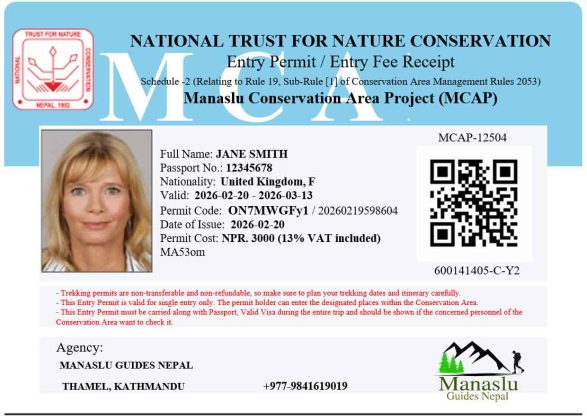
In Manaslu Region Trek or Manaslu Circuit Trek passes through the Manaslu Conservation Area, a diversified protected area in the region. To enter the Conservation Area, In addition to the restricted area permit, trekkers need the Manaslu Conservation Area Permit (MCAP). This permit costs USD 30 per person and is necessary to enter the conservation area. Unlike the Manaslu Restricted Area Permit, the Manaslu Conservation Area Permit remains unchanged. The costs of MCAP are as follows:
- For SAARC Nationals will cost 10 USD i.e. NPR 1000 per pax.
- For Non-SAARC Nationals will cost 30 USD i.e. NPR 3000 per pax.
Annapurna Conservation Area Permit (ACAP):
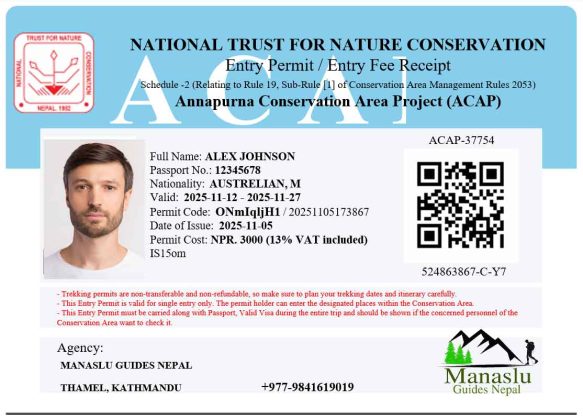
Since the Manaslu Circuit Trek route merges with the Annapurna region towards the end, trekkers must also obtain the Annapurna Conservation Area Permit (ACAP). Like MCAP. This Manaslu trek permit is necessary from Dharapani till you exit ACAP at Beshi Sahar or carry on your trek towards Annapurna Circuit. The pricing remains the same throughout the year: USD 30 per person. Also, there are no restrictions or pricing changes based on the amount of days spent inside ACAP. This Permit costs:
- For SAARC Nationals will cost 10 USD i.e. NPR 1000 per pax.
- For Non-SAARC Nationals will cost 30 USD i.e. NPR 3000 per pax.
Tsum Valley Restricted Area Permit (TVRAP)
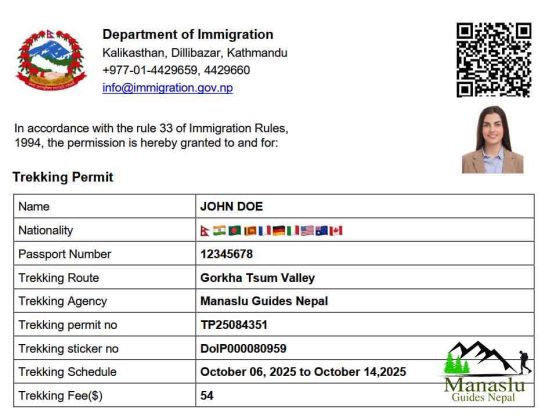
Tsum Valley also lies within the beautiful Manaslu Region of Nepal. If trekkers wish to include Tsum Valley in their Manaslu Circuit Trek itinerary, or if they plan to trek only in Tsum Valley, they must obtain the Tsum Valley Restricted Area Permit in addition to the Manaslu permits. As Tsum Valley is classified as a restricted area to preserve its unique Tibetan-influenced culture, ancient monasteries, and traditional Himalayan villages, the Tsum Valley Restricted Area Permit (RAP) is mandatory for all foreign trekkers.
This special permit is issued by the Department of Immigration and can only be arranged through a registered Nepali trekking agency. Independent or solo trekking is not allowed in this region, and a minimum of two trekkers accompanied by a licensed guide is required. These regulations help protect the fragile environment and safeguard the cultural heritage of this sacred Himalayan valley.
Tsum Valley Restricted Trekking Permit Costs:
- From September to November, cost of a Tsum Valley permit is USD 40 per person for the first week and after Seven Days, USD 7 each additional day.
- From December to August, cost of a Tsum Valley Restricted Permit is USD 30 per person for the first week and then an additional USD 7 per day.
Nar Phu Valley Restricted Area Permit (NVRAP)
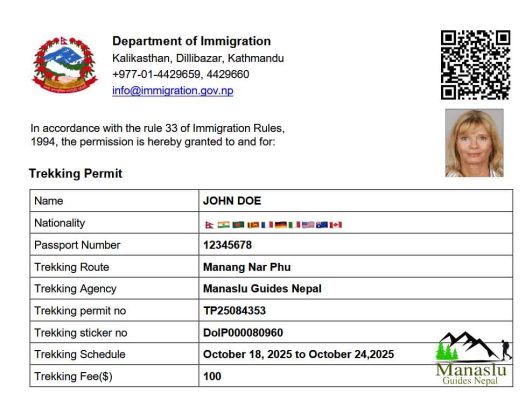
Nar Phu Valley also lies in the northern part of the Annapurna Region of Nepal, close to the Tibetan border. If trekkers wish to include Nar and Phu villages after their Manaslu Circuit Trek or in their Annapurna Circuit itinerary, or if they plan to explore only Nar Phu Valley, they must obtain the Nar Phu Valley Restricted Area Permit (NVRAP) in addition to the Annapurna Conservation Area Permit (ACAP).
As Nar Phu is designated as a restricted area to protect its ancient Tibetan culture, medieval stone villages, monasteries, and untouched Himalayan landscapes, the Nar Phu Valley Restricted Area Permit (RAP) is mandatory for all foreign trekkers. This special permit is issued by the Department of Immigration and must be arranged through a registered Nepali trekking agency. Independent or solo trekking is not permitted in this region, and a minimum of two trekkers accompanied by a licensed guide is required. These regulations help preserve the unique cultural heritage and fragile mountain environment of this remote Himalayan valley.
Nar Phu Valley Restricted Area Trek Permit Costs
- The cost of a Nar Phu Valley Restricted Area Permit (NVRAP) is USD 100 per person for the first 7 Days and after 7 days USD 15 each additional day from September to November.
- From December to August. Nar Phu Valley Restricted Permit Cost USD 75 per person for the first week and then an additional USD 15 per day.
Trekking Information Management System (TIMS) Permit
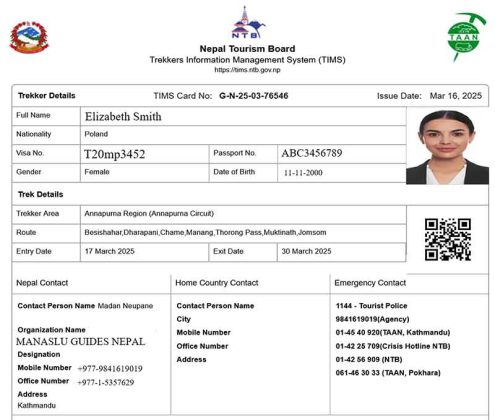
The Trekking Information Management System (TIMS) is a trekking registration system introduced by the Trekking Agencies’ Association of Nepal (TAAN) in coordination with the Nepal Tourism Board (NTB). The purpose of the TIMS card is to ensure the safety and security of trekkers in Nepal by maintaining an official record of trekkers and trekking routes. It also helps authorities locate trekkers quickly in case of emergencies such as natural disasters, accidents, or health issues in remote mountain regions.
The TIMS system also supports sustainable tourism management by monitoring trekking activities and helping regulate the flow of visitors into popular trekking areas.
When is TIMS Required?
A TIMS card is generally required for most popular trekking regions in Nepal, including:
- Annapurna Region (standard routes)
- Langtang Region
- Everest Region (for certain routes outside national park permits)
- Other non-restricted trekking areas
Trekkers must obtain a TIMS card either through a registered trekking agency or directly from TAAN offices in Kathmandu or Pokhara (for independent trekkers, where allowed).
When is TIMS NOT Required?
TIMS is not required for restricted area treks where a special Restricted Area Permit (RAP) is already mandatory. These regions include:
- Manaslu Region
- Tsum Valley
- Nar Phu Valley
- Upper Mustang
- Upper Dolpo
In these restricted areas, the Restricted Area Permit (RAP) replaces the need for a TIMS card because trekkers are already registered and monitored by the Department of Immigration.
Cost of Trekking Information Management System (TIMS) Permit For non-SAARC nationals USD 20 i.e. NPR 2000 Per Traveler and for SAARC nationals will cost USD 10 i.e. NPR 1000 Per Traveler.
For trekkers seeking broader information beyond the permits required for the Manaslu region, we have prepared a comprehensive guide covering all major trekking permits and entrance fees across Nepal. This includes details about conservation area permits, restricted area permits, national park entry fees, and updated government regulations. If you would like to explore complete information about trekking permits throughout Nepal, please visit our parent company Touch The Himalaya Treks and Expedition and read the full guide here: Nepal Trekking Permits and Entrance Fees. This resource provides up-to-date, detailed information to help you prepare properly for any trekking destination in Nepal.
Nepal Trekking Permit Rules and Regulation
Trekking permits in Nepal are mandatory for most popular trekking regions. The government enforces these rules to protect natural heritage, regulate tourism, and ensure trekker safety. Before starting any trek, travelers must obtain the correct permits based on the region they are visiting.
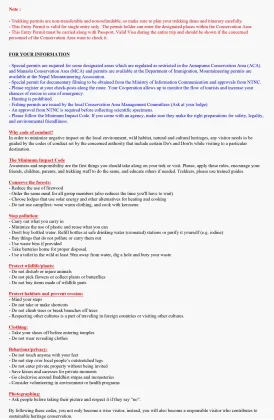
Note :
- Trekking permits are non-transferable and non-refundable, so make sure to plan your trekking dates and itinerary carefully.
- This Entry Permit is valid for single entry only. The permit holder can enter the designated places within the Conservation Area.
- This Entry Permit must be carried along with Passport, Valid Visa during the entire trip and should be shown if the concerned personnel of the Conservation Area want to check it.
FOR YOUR INFORMATION
- Special permits are required for some designated areas which are regulated as restricted in the Annapurna Conservation Area (ACA) and Manaslu Conservation Area (MCA) and permits are available at the Department of Immigration, Mountaineering permits are available at the Nepal Mountaineering Association.
- Special permit for documentary filming to be obtained from the Ministry of Information Communication and approvals from NTNC.
- Please register at your check-posts along the route. Your Cooperation allows up to monitor the flow of tourists and increase your chances of rescue in case of emergency.
- Hunting is prohibited.
- Fishing permits are issued by the local Conservation Area Management Committees (Ask at your lodge)
- An approval from NTNC is required before collecting scientific specimens.
- Please follow the Minimum Impact Code. If you come with an agency, make sure they make the right preparations for safety, legality, and environmental friendliness.
Why code of conduct?
In order to minimize negative impact on the local environment, wild habitat, natural and cultural heritages, any visitor needs to be guided by the codes of conduct set by the concerned authority that include certain Do’s and Don’ts while visiting to a particular destination.
The Minimum Impact Code
Awareness and responsibility are the first things you should take along on your trek or visit. Please, apply these rules, encourage your friends, children, parents, and trekking staff to do the same, and educate others if needed. Trekkers, please use trained guides.
Conserve the forests:
- Reduce the use of firewood
- Order the same meal for all group members (also reduces the time you’ll have to wait)
- Choose lodges that use solar energy and other alternatives for heating and cooking
- Do not use campfires: wear warm clothing, and cook with kerosene.
Stop pollution:
- Carry out what you carry in
- Minimize the use of plastic and reuse what you can
- Don’t buy bottled water. Refill bottles at safe drinking water (ozonated) stations or purify it yourself (e.g. iodine)
- Buy things that do not pollute or carry them out
- Use waste bins if provided
- Take batteries home for proper disposal.
- Use a toilet in the wild at least 50m away from water, dig a hole and bury your waste
Protect wildlife/plants:
- Do not disturb or injure animals
- Do not pick flowers or collect plants or butterflies
- Do not buy items made of wildlife parts
Protect habitats and prevent erosion:
- Mind your steps
- Do not take or make shortcuts
- Do not climb trees or break branches off trees
- Respecting other cultures is a part of traveling in foreign countries or visiting other cultures.
Clothing:
- Take your shoes off before entering temples
- Do not wear revealing clothes
Behaviour/privacy:
- Do not touch anyone with your feet
- Do not step over local people’s outstretched legs
- Do not enter private property without being invited
- Save kisses and caresses for private moments
- Go clockwise around Buddhist stupas and monasteries
- Consider volunteering in environment or health programs
Photographing:
- Ask people before taking their picture and respect it if they say ”no”.
- By following these codes, you not only become a wise visitor, instead, you will also become a responsible visitor who contributes to sustainable heritage conservation.
Frequently Asked Questions About Manaslu Trek Permits (FAQs)
What are the required permits for the Manaslu circuit trek?
Restricted area permits for Manaslu (Manaslu RAP), Manaslu Conservation Area Permit (MCAP), Annapurna Conservation Area Permit (ACAP), and TIMS card-trekkers’ information management system.
How to get Manaslu trek permits?
All needed permits can be arranged by the local trekking agency but you need to be accompanied by a registered Nepali trekking agency they will ask you for your passport and passport-size photos other needed documents can be your trekking itinerary and insurance details. And they will arrange the required permits to trek for the Manaslu trek.
How many permits are required in Manaslu Region Trek?
The required permits for Manaslu Region Treks are :
Manaslu Restricted Permits (MRAP)
Tsum Valley Restricted Area Permit (TVRAP)
Manaslu Conservation Area Permit (MCAP)
Annapurna Conservation Area Permit (ACAP)
Manaslu Rural Government fee
Can I get Manaslu permit on arrival?
No. Only registered agencies can issue RAP.
How long is the RAP valid?
Normally Restricted Area Permits valid 7 days, extendable with extra daily fee.
Is TIMS required for Manaslu?
Usually TIMS card are not required separately when RAP is issued.
Do I need travel insurance for permit?
No, Its not mandatory specially to issue the permits, However insurance that coverage 5,500 meter and evacuation is very important.
Cost of Manaslu Region’s Treks trek permits?
Manaslu’s Restricted Area Permit:
Peak season: around USD 100 per person per week (September to November)
Off-season (December to August): Each individual pays roughly USD 75 each week.
Permit for the Annapurna Conservation Area Project (ACAP):
About USD 30 for every individual
Permit for the Manaslu Conservation Area Project (MCAP):
About USD 30 for every individual
Trailblazers’ Information Management System (TIMS) Card:
Utilizing a guide: around USD 20 for every individual
Individual hikers (not applicable to Manaslu): around USD 40 each
Is the Manaslu Trek difficult?
The trek is considered challenging due to its long distance, high altitude (Larkya La Pass at 5,106m), and rugged terrain. Proper acclimatization and physical fitness are essential for a successful trek.
Do I need a guide for the Manaslu Trek?
Yes, hiring a registered guide and trekking in a group of at least two people (excluding the guide) is mandatory as Manaslu is a restricted area.
Can I get permits on my own?
No, permits must be obtained through a registered trekking agency in Nepal, as they need to arrange your guide and other logistics.
Is the Manaslu Trek crowded?
The Manaslu region is less crowded than the Everest or Annapurna regions, making it a great choice for trekkers looking for a more remote and peaceful experience.
What are the accommodation options?
Teahouses (small lodges) are available throughout the trek, offering basic rooms and meals. However, they are more basic and less developed compared to those in the Annapurna or Everest regions.
Manaslu Guides Nepal organizes Famous Trek in Manaslu Region:
Manaslu circuit trek
The Manaslu Circuit Trek is an incredible tour around the world’s eighth-highest peak, Mount Manaslu. This walk provides an ideal balance of action, cultural exploration, and breathtaking Himalayan scenery.
The walk begins in Machha Khola and continues along the Budhi Gandaki River, passing through rural Manaslu circuit trek villages, lush woods, and terraced crops. The trail steadily ascends, going through Jagat, Deng, Namrung, and Samagaon before arriving at the lovely settlement of Samdo. Trekkers leave Samdo and traverse the difficult Larkya La Pass (5,160 meters), which provides stunning views of the surrounding Himalayas. The descent takes you through the serene alpine meadows of Bimthang before returning to the starting point via Tilije and Tal. From there, you may catch a ride in a Jeep from Dharapanin and drive back to Kathmandu or Pokhara through Besisahar.
Tsum valley Manslu trek
One of the most well-known trekking destinations these days is Tsum Valley, which is northeast of Manaslu. Trekkers can experience both the natural and cultural aspects of the Tsum Valley, located in Gorkha’s western section. This journey is an extension of the Manaslu Circuit journey; it can also be done as the Manaslu Tsum Valley Trek, combining the two treks.
Approximately eight hours from Kathmandu, our Tsum Valley with Manaslu Circuit Trek starts with an enthralling journey through verdant hills and riverbanks to Machha Khola. We proceed with our journey, navigating through forests of pine and rhododendron that lead to Lokpa via Jagat. The paths wind through terraced fields, woodlands, and the Budhi Gandaki River.
After completing the Manaslu trek, we will transition into the secluded Tsum Valley, rich in Tibetan culture and tradition, featuring prayer flags and mani walls. Highlights of the journey include stunning snow-capped peaks, monasteries, waterfalls, and diverse flora and fauna. Key sites to visit are Mu Gompa monastery, Gumba Lungdang, and Ganesh Himal Base Camp. The trek involves passing Larke La Pass, Sama, Samdo, and a detour to Rui La Pass near the Tibet border, concluding at Dharapani, from where we will either head to Pokhara or return to Kathmandu.
Manaslu three-pass trek
Trekking Tsum Valley, Manaslu, Nar Phu Valley, Tilicho Lake, and the Annapurna Circuit are all included in the 34-day Manaslu Three Pass Trek. It begins at Soti Khola and travels past Philim hamlet before providing sweeping views of nearby peaks and Mount Manaslu (8,163m). Three high passes are traversed during the route: Thorong-La (5,416m), Kang-La (5,306m), and Larkya La (5,160m). Highlights include the distant landscapes, the Tibetan Buddhist culture of Tsum Valley, Bimthang Valley, and Manaslu Base Camp (4,700m). This strenuous hike offers breathtaking natural beauty and cultural encounters in less-traveled regions of Nepal.
Nar Phu Valley Round Annapurna Trek
A difficult and rewarding trekking route that combines the traditional Annapurna Circuit with a diversion to the isolated Nar and Phu valleys in the Annapurna region of Nepal is the Nar Phu Valley Round Annapurna Trek. The difficult and isolated Manaslu Narphu Trek offers hikers a singular chance to see the varied topography, vegetation, and wildlife of the Manaslu and Annapurna regions. Participants should be mentally and physically prepared for the strenuous hike and the rugged, hilly terrain. But the trip is well worth it because you will witness the distinct local culture and the natural beauty and diversity of the Himalayas.
Tsum valley trek
The Gorkha district of Nepal has a rural valley called Tsum Valley Trek. The Himalayas encircle the valley, which has a rich cultural and ecological past. Though the valley was only made accessible to hikers in 2008, it is still regarded as one of Nepal’s least well-liked trekking destinations and is a hidden treasure among the country’s mountains.
Tsum Valley Trek is well known for its ancient Buddhist culture and traditions. The valley is lined with numerous monasteries, mani walls (stones engraved with prayers), and chorusens (Buddhist shrines). It is believed that Milarepa, a well-known Buddhist saint, meditated in this valley on her way to Tibet. The trek to Tsum Valley Trek begins and ends in the little Gorkha town of Arughat and takes 13 to 15 days. The hike passes through several small communities, such as Chumling, Chhekampar, and Mu Gompa.
The valley is surrounded by mountains, namely Ganesh Himal, Sringi Himal, and Boudha Himal. One of the trek’s unique aspects is the opportunity to experience the customs and culture of the area. With many cultural parallels to Tibet, the Tsum Valley Trek area is home to a large population of Tibetan heritage. The excursion provides an opportunity to become familiar with the customs and way of life of the kind and welcoming natives.


